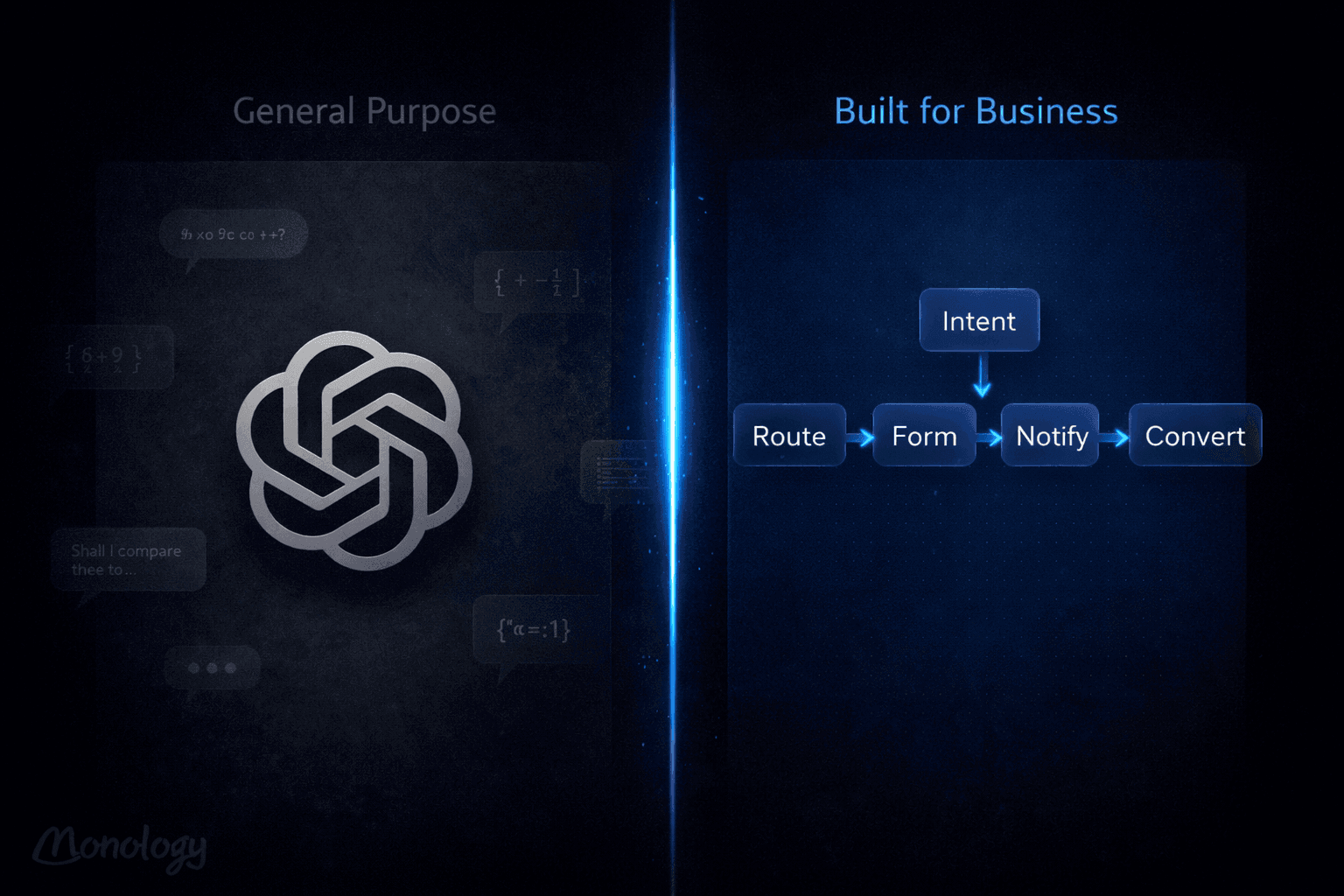
Let's start with something honest: ChatGPT is genuinely impressive.
It can write, summarise, explain, debug, translate, and brainstorm at a level that would have seemed impossible five years ago. Millions of people use it every day for good reason. If you're using it to draft emails, research topics, or think through problems — keep going. It's excellent at that.
But there's a version of this conversation that happens constantly in small business owner circles, founder Slack groups, and marketing team standups:
"We just added ChatGPT to our website — it's our chatbot now."
And every time I hear it, I want to ask: does it qualify your leads? Does it route job applicants away from your sales team? Does it send you a Slack notification when a high-value prospect submits a form at 11 PM? Does it know what your pricing actually is, what your process looks like, and what you do and don't handle?
Usually the answer is no. Because ChatGPT — as brilliant as it is — isn't built for that. It's a general-purpose AI assistant. Your business has specific purposes.
This post isn't anti-ChatGPT. It's a clear-eyed comparison of two fundamentally different tools, so you can decide which one — or which combination — actually fits what you're trying to do.
What You're Actually Comparing
Before the side-by-side, it's worth being precise about what we're comparing.
ChatGPT (specifically the web interface at chat.openai.com, or the API used without a wrapper) is a general-purpose conversational AI. It's trained on a broad slice of the internet and can respond to almost any question with reasonable intelligence. It has no inherent awareness of your business, your products, your customers, or your processes — unless you tell it in the conversation itself.
A purpose-built chatbot — built on a platform like Monology — is a structured workflow that uses AI (including the same underlying models as ChatGPT, like GPT-4o) but wraps it in business logic: conditional routing, structured data collection, knowledge bases built from your own content, integrations with your tools, and analytics on every conversation. The AI is the engine. The workflow is the vehicle.
That distinction matters more than it might seem.
Round 1: Handling Your Specific Business Context
ChatGPT
ChatGPT knows nothing about your business by default. If a visitor opens ChatGPT on your website and asks "What's your pricing?" — ChatGPT either admits it doesn't know, or worse, makes something up that sounds plausible but is completely wrong.
You can give ChatGPT a system prompt with context about your business, but that context lives only in that conversation window. There's no persistent knowledge base. There's no connection to your actual documentation, pricing pages, or service descriptions. Every new conversation starts from zero.
For general Q&A with a visitor who knows nothing about your business yet, ChatGPT will often produce responses that are fluent but inaccurate — and a confidently wrong AI is worse than no AI at all.
Purpose-Built Chatbot (Monology)
In Monology, the Agent Node connects directly to your knowledge base — uploaded as PDFs, CSVs, or website URLs that Monology crawls and indexes. When a visitor asks about your pricing, the Agent Node pulls from your actual pricing documentation. When they ask about your process, it references your actual process description.
The AI isn't guessing. It's reading from what you've written.
This is the difference between a brilliant generalist who's never heard of your company and a knowledgeable team member who's read every piece of documentation you've ever produced. The underlying model might be the same GPT-4o under the hood — but the knowledge it operates from is entirely yours.
Winner: Purpose-built chatbot. Not close.
Round 2: Lead Qualification and Routing
ChatGPT
ChatGPT can have a conversation. It can even ask qualifying questions if you prompt it to. But it has no mechanism to do anything with that information once it has it. It can't route the conversation. It can't trigger a form. It can't send your sales team a notification. It can't tell the difference between a job applicant and a client lead and take different actions accordingly.
Every conversation is a conversation — and nothing more. The information goes nowhere. It does nothing. It's a chat window, not a business system.
Purpose-Built Chatbot (Monology)
This is where structured workflows become genuinely powerful. In Monology, the IT Services Intent Classifier — a dedicated DistilBERT-based classification model — reads visitor intent and classifies it into one of seven categories: Requirement Submission, General Query, Contact Details, Feedback Submission, Appreciation, Greeting, or Job Application Submission. It does this with approximately 95% accuracy, without consuming LLM tokens for the classification step.
That classified intent then feeds into a Condition Node, which routes the conversation: potential clients go to a lead capture form; job applicants go to a tailored response path; general queries go to an FAQ-answering Agent Node backed by your knowledge base.
Each visitor type gets a completely different, optimised experience — automatically, based on what they actually want — without a human making those routing decisions in real time.
An Action Node then fires: a Slack message, an email notification, a CRM API call — using dynamic variables populated from the conversation: {{form.name}}, {{form.email}}, {{agent.visitor_intent}}. Your team gets a fully formatted lead summary the moment it happens.
ChatGPT cannot do any of this. It's not designed to.
Winner: Purpose-built chatbot. By a large margin.
Round 3: Data Ownership and Privacy
ChatGPT
When visitors chat through ChatGPT — whether via the web interface or the API embedded on your site — those conversations are processed by OpenAI's infrastructure. Depending on your API configuration, they may be used to improve OpenAI's models. Even with privacy settings adjusted, your customer conversations are passing through a third party's systems with data practices you don't control.
For businesses handling sensitive client information — IT service companies, consultancies, professional services firms — this is not a theoretical concern. It's a real compliance and trust question.
Purpose-Built Chatbot (Monology)
Monology is built around a critical architectural principle: you bring your own API keys.
Your OpenAI or Azure OpenAI credentials connect directly to the Agent Node. Monology acts as the workflow orchestration layer — it doesn't sit between you and your LLM provider in a way that touches or stores your conversation content on its servers in an opaque way. Your costs are transparent because you see them directly in your OpenAI dashboard. Your data flows through infrastructure you control.
Additionally, Monology's Widget Integration Settings let you configure origin whitelisting — so only your domains can embed and trigger the widget — and per-IP or per-session daily token limits, which prevent abuse and runaway costs. These are controls ChatGPT's web interface simply doesn't offer.
Winner: Purpose-built chatbot. Data control and cost transparency are not optional for serious business use.
Round 4: Conversation Analytics and Improvement
ChatGPT
If you embed ChatGPT on your website and visitors use it, what do you learn? Almost nothing you can act on. You have no visibility into what questions are being asked most frequently, which conversations convert to leads, which paths visitors abandon, or what's confusing people about your services.
There's no dashboard. No conversation log you own. No form submission tracking. No way to systematically improve the experience based on what you observe.
Purpose-Built Chatbot (Monology)
Every conversation that passes through a Monology workflow is logged in the Conversations section — complete message history, form submissions, user device and location metadata, associated workflow and widget, and message counts. You can filter by workflow, widget, form status, date range, or device type.
The Dashboard surfaces aggregate metrics: total conversations, total messages, form submission counts, and performance broken down by workflow. You can identify peak conversation hours — when your visitors are most active — and compare performance across different workflows to see what's working and what isn't.
This is the difference between running a business system and using a black box. Every interaction is a data point you own and can learn from.
Winner: Purpose-built chatbot. Analytics aren't a luxury — they're how you improve.
Round 5: Flexibility and General Intelligence
ChatGPT
Here's where ChatGPT genuinely wins — and it's worth being honest about it.
For open-ended, unpredictable conversations that require broad general knowledge, lateral thinking, and creative responses, ChatGPT is exceptional. If a visitor asks something completely outside the scope of your business, ChatGPT will handle it gracefully. If someone uses phrasing you'd never have anticipated, ChatGPT improvises well.
It's also continuously updated with newer model versions, reasoning improvements, and capabilities like image understanding and code execution. As a general-purpose AI assistant living on the frontier of what's possible, it moves fast.
Purpose-Built Chatbot (Monology)
A Monology workflow is structured by design. That structure is its strength for business use — but it does mean conversations that go wildly off-script need to be handled gracefully. A well-written system prompt and a thoughtful fallback path in your Condition Node handle the majority of unexpected inputs, but a purpose-built chatbot is deliberately scoped to your use cases rather than all possible use cases.
That said: because Monology's Agent Node uses GPT-4o or GPT-4o-mini as its underlying model, you get the same raw intelligence — just channelled through business logic rather than left free-ranging. You're not sacrificing model quality for structure. You're adding structure on top of quality.
Winner: ChatGPT — for pure open-ended conversational flexibility. But for 95% of real business chatbot use cases, this flexibility is not what you actually need.
Round 6: Setup, Maintenance and Cost
ChatGPT
Embedding ChatGPT on your website via the API requires API key management, a front-end implementation (either custom code or a third-party wrapper), rate limiting on your end, and ongoing prompt maintenance. If you're using the ChatGPT web interface directly, there's nothing to set up — but then you have no custom knowledge base, no integrations, and no control over the experience.
Cost-wise, OpenAI charges per token consumed. Without usage controls, a busy website can generate significant and unpredictable bills — and without token limits or origin whitelisting, a single determined user could exhaust your daily quota.
Purpose-Built Chatbot (Monology)
Monology's visual workflow builder — the drag-and-drop canvas with Start, Agent, Condition, Form, Static Message, Action, and End nodes — is designed for non-technical users. Building a complete lead qualification and routing workflow takes a few hours, not weeks. Updates to the workflow are made visually, tested in Live Preview, and deployed instantly.
Cost is predictable: a flat Monology subscription plus your actual OpenAI API usage, which you see directly in your OpenAI dashboard. The daily token limit settings in Widget Integration Settings give you hard caps per user, preventing runaway usage before it becomes a bill.
Winner: Purpose-built chatbot — for long-term manageability, cost predictability, and accessibility to non-technical owners.
The Honest Summary: Side-by-Side
| Capability | ChatGPT | Monology (Purpose-Built) |
|---|---|---|
| Your business knowledge base | ❌ None by default | ✅ PDF, CSV, website links |
| Lead qualification | ❌ Conversation only | ✅ Intent classification + form capture |
| Visitor routing (client vs. applicant) | ❌ Not possible | ✅ Condition Node + Intent Classifier |
| CRM / Slack / email notifications | ❌ No integrations | ✅ Action Node with dynamic variables |
| Data ownership | ⚠️ OpenAI's infrastructure | ✅ Your own API keys |
| Conversation analytics | ❌ No dashboard | ✅ Full conversation logs + dashboard |
| Token cost control | ⚠️ Manual, requires custom code | ✅ Built-in daily limits per IP/session |
| Security (origin whitelisting) | ❌ Not available | ✅ Widget integration settings |
| No-code setup | ⚠️ Depends on implementation | ✅ Visual drag-and-drop builder |
| Open-ended general intelligence | ✅ Excellent | ✅ Same models, scoped to your use case |
| Handles off-script conversations | ✅ Very well | ⚠️ Requires thoughtful fallback design |
The Real Question: What Are You Actually Trying to Do?
Here's the decision framework I'd use:
Use ChatGPT if:
- You need a general-purpose AI assistant for your own work — writing, research, analysis, brainstorming
- You're building a product that needs broad, open-ended conversational AI as a component
- Your use case genuinely requires handling any topic a user might raise, with no specific business context needed
- You have a development team to build and maintain the surrounding infrastructure
Use a purpose-built chatbot (Monology) if:
- You want your website to qualify and capture leads automatically — especially outside business hours
- You're an IT service company, agency, or consultant getting both client enquiries and job applications through the same contact point
- You need the chatbot to know about your specific services, pricing, and process — not generic internet knowledge
- You want Slack or email notifications the moment a high-value lead submits their details
- You need full control over your data, your costs, and your conversation analytics
- You're a non-technical business owner who wants to build and manage this yourself without a developer
Use both — in their right places:
This is actually the most sophisticated answer, and it's more common than people expect. Use ChatGPT for your personal productivity — drafting, thinking, writing. Use a purpose-built Monology workflow for your customer-facing website — where accuracy, routing, integrations, and data ownership are non-negotiable.
They're not competitors. They're different tools for different jobs. The mistake is treating a general-purpose AI as a business system, or expecting a business-specific workflow to replace a general-purpose thinking tool.
A Concrete Example: The Same Visitor, Two Experiences
Let's make this tangible. A visitor lands on an IT services company's website at 9:30 PM and types:
"Hi, we're a 50-person company looking to outsource our IT support. What would that cost?"
With ChatGPT on the website:
ChatGPT generates a thoughtful, well-written response about IT outsourcing costs — drawing from general internet knowledge. It might mention typical industry ranges, factors that affect pricing, questions to consider. It's intelligent and fluent.
But it doesn't know what this company charges. It doesn't capture the visitor's name or email. It doesn't notify anyone that a potential $5,000/month client just asked about pricing at 9:30 PM. It doesn't route them to a next step. It just... answers.
Tomorrow morning, no one on the team knows this conversation happened.
With a Monology workflow:
The Agent Node reads the message. The IT Services Intent Classifier classifies it as Requirement Submission. The Condition Node routes to the client path. A Static Message Node says "Great timing — let me grab a few details so our team can give you accurate pricing for your setup."
The Form Node renders: name, email, company, brief description. The visitor fills it in and submits.
The Action Node fires a Slack notification: "🔔 New lead — 50-person company looking for full IT outsourcing. Email: [contact]. Submitted 9:32 PM."
A confirmation Static Message Node thanks them by name and sets expectations for follow-up.
By 9:33 PM, the lead is captured, qualified, notified, and confirmed — with zero human involvement.
Same visitor. Same question. Completely different outcome.
The Bottom Line
ChatGPT is one of the most remarkable pieces of software ever built for general-purpose intelligence. For personal productivity, broad research, and creative work — it's exceptional.
But your business website isn't a general-purpose AI playground. It's a conversion surface. Every visitor who lands on it is a potential lead, a potential hire, a potential client — and what happens in the first 30 seconds of their interaction with your site determines whether they stay or leave, submit or bounce, come back or go to a competitor.
For that specific job — capturing, qualifying, routing, notifying, and converting website visitors — a purpose-built chatbot workflow built on something like Monology does things ChatGPT simply cannot: it knows your business, it routes intelligently, it captures data, it sends notifications, it lets you see what's working, and it gives you control over your costs and your data.
The question was never "is ChatGPT good?" It clearly is.
The question is: is it the right tool for this specific job?
For most business website use cases, the answer is no. And the alternative is easier to build than you think.
Start your 11-day free trial at monology.io — no credit card required. Build your first workflow and see the difference for yourself.